At recent local anti-immigration protests, the use of Christian slogans and values has been increasing, pointing to differences between religions of asylum seekers and Christianity. The anti-immigration movement often states one of their main goals is to “restore Christian values”.
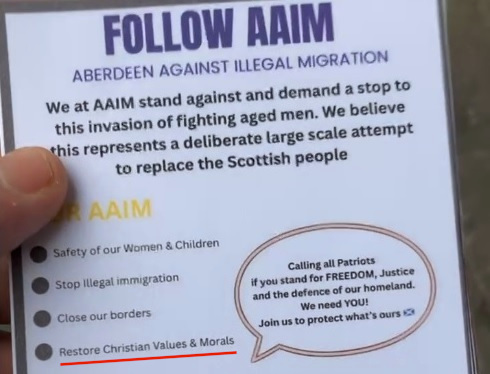
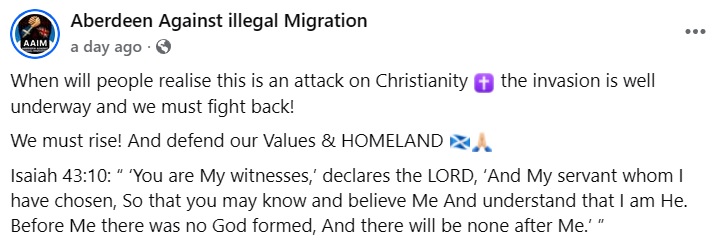
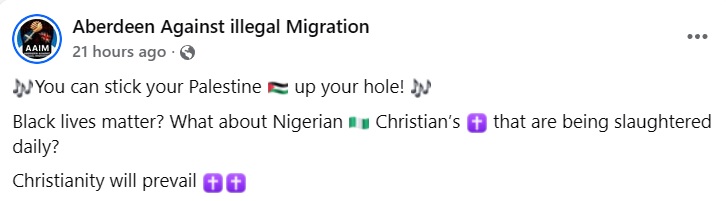
Protesters display banners reading “Jesus is King” and quote bible passages at rallies, using religious language to frame opposition to immigration. The use of Christian values in this way suggests that there is a threat being presented to those values, by asylum seekers.
But what does the church community say? How do these actions of protest reflect Christian values on a national and local level?
Religion in Scotland
According to the most recent census, the majority of people in Scotland report no religious affiliation, with 51% of the population stating no religion. This shows that while religion is sometimes invoked in public debates, it does not reflect the beliefs or daily lives of most Scottish residents.
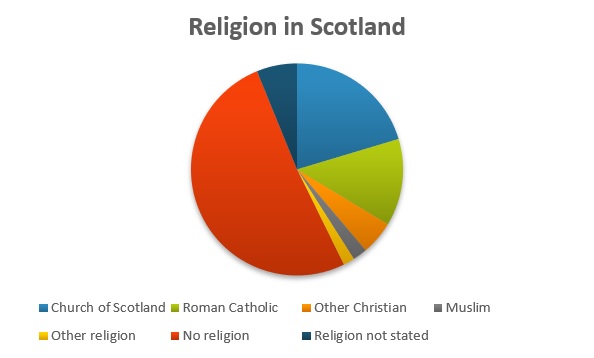
It’s also worth noting that only 2.2% of people in Scotland are Muslim.
Church of Scotland values
In the 2022 census, the Church of Scotland was the most named denomination among those who identify as Christian.
On their website, the Church of Scotland describes its role in the community in practical terms. Under “our role in the community”, asylum seekers are named directly. The Church states:
“Pastoral care of parishioners is an essential part of Christ’s calling to the Church, particularly in times of need. As part of their caring task, local churches also aim to resource and run projects relating to groups such as asylum seekers and unemployed people.”
Here, Christian values are expressed through ideas such as pastoral care, helping people in need, and supporting vulnerable groups within the community.
Church of Scotland comment on the protests
The moderator of the General Assembly of the Church of Scotland has publicly criticised the anti-immigration protests, describing them as distressing and saying they make her “so ashamed of Scotland”.
This highlights a clear conflict between the values and responsibilities of the Church of Scotland and the way Christianity is being used by anti-immigration protesters.
Do local churches in Aberdeen and Aberdeenshire support asylum seekers?
Many local churches are actively supporting asylum seekers.
In Aberdeen and surrounding areas, churches collect donations of clothes, phones, and other essentials. They also run conversation cafes, helping asylum seekers learn English and form social connections.
For example, in Westhill, an anti-immigration protest hotspot:
Kingshill Parish Church in Westhill provides many forms of direct support to asylum seekers staying at the Hampton by Hilton Westhill.
Westhill Community Church also provides support in the form of clothes donations.
A clear contrast
Anti-immigration groups often frame asylum seekers as morally and culturally different from Christian communities, while simultaneously raising lack of integration as an issue. Yet local churches are actively collecting donations, running conversation cafes and providing support specifically to help asylum seekers integrate in the community.
On a national level, the anti-immigration protests have been denounced by the Church of Scotland.
Simply put, religious symbolism at anti-immigration protests, such as banners, bible quotes and speeches, doesn’t reflect the practical actions, beliefs or values of the Christian community in Scotland.
Some questions
Given this contrast, several questions are raised.
Does it make sense for protesters to frame their anti-immigration stance in religious terms?
If local churches themselves are actively supporting asylum seekers, what does this tell us about the use of religion in protest rhetoric?
Have anti-immigration protest groups, such as AAIM, communicated with the local church communities? If not, why not?